
Performance Anxiety: The Loop and How To Break It
The frustrating part is that worrying about it is not a reaction to the problem. It is a second, entirely separate cause of it.
Almost every man who has had one disappointing night has then spent part of the following one checking. Not consciously deciding to check — just noticing, monitoring, running a quiet internal commentary on whether things are proceeding as they should. That monitoring is the whole mechanism, and understanding why turns a vague and humiliating experience into something with a plainly physical explanation.
Two nervous systems, pulling in opposite directions
The autonomic nervous system has two branches. The parasympathetic branch handles rest, digestion and, relevantly here, erection. The sympathetic branch handles threat: heart rate up, breathing fast, blood diverted from the periphery toward the large muscles. It is the system that prepares you to run.
An erection is a parasympathetic event. It requires the arteries feeding the erectile tissue to relax and widen. Sympathetic activity does the precise opposite — adrenaline is a potent constrictor of those same small arteries. The two states are not merely different moods; they are mechanically incompatible.
You cannot be braced for a threat and relaxed enough to fill with blood at the same time. The body treats those as different jobs.
So when a man's attention shifts from what is happening to whether it is going to work, he has recruited the threat system into a situation that requires its opposite. The anxiety does not metaphorically get in the way. It vasoconstricts.
Why one bad night reliably becomes three
The loop closes quickly and each turn is small enough to seem unremarkable.
Something goes wrong once, usually for a mundane reason: too much to drink, exhaustion, an argument earlier, a heavy meal, a week of bad sleep. The next occasion arrives with a question attached. Attention splits between the encounter and the monitoring. The monitoring raises sympathetic tone. Sympathetic tone narrows the arteries. The result is worse than it needed to be, which confirms the worry and makes the following occasion harder still.
By the third or fourth repetition the original cause is long gone and irrelevant. The man is now responding to his own track record. This is why "it's all in your head" is such an unhelpful thing to be told: the anxiety is producing a genuine physical constriction, and being informed the problem is imaginary tends to add embarrassment to a list that was already long enough.
Spectatoring, and why it is so effective at ruining things
Sex researchers gave this a name decades ago: spectatoring. Instead of participating in an experience, a person observes themselves having it and evaluates the performance in real time.
Arousal depends on attention being on sensation. Attention spent on assessment is attention not spent on the input that generates the nitric oxide signal in the first place. So spectatoring attacks the problem from both ends at once — it raises the constricting signal and starves the dilating one.
How to tell whether anxiety is the main driver
Not definitive, but a reasonable indication. Anxiety-driven difficulty tends to be situational: fine alone, fine with a long-term partner but not a new one, fine on holiday but not at home, morning erections present and normal. Vascular difficulty tends to be consistent — the same regardless of circumstance, and accompanied over time by fewer spontaneous and morning erections.
Plenty of men have both, and the two feed each other. A small physical shift produces one failure, anxiety amplifies the next several, and by the time it is being described to anyone the two are indistinguishable from the inside.
What actually helps
Take the outcome off the table. The single most effective intervention is deciding, in advance and genuinely, that intercourse is not the objective for a set period. If there is no test, there is nothing to fail, and the monitoring has no purpose. Sex therapists have used structured versions of this for decades precisely because removing the goal removes the threat.
Return attention to sensation deliberately. When you notice yourself evaluating, the instruction is not to stop worrying — that never works — but to move attention to something physical and specific. Touch, temperature, breathing. It is the same move meditation practice teaches, applied somewhere useful.
Say something out loud. Counterintuitive and unpopular, and it works. A large part of the pressure comes from imagining what a partner is concluding, which is almost always harsher than what they are actually thinking. Naming it converts a private emergency into a shared and rather ordinary situation.
Slow the exhale. Extending the out-breath longer than the in-breath raises parasympathetic tone measurably within a minute or two. It is not a cure, but it moves the balance in the right direction and it can be done without anyone noticing.
Deal with the alcohol tactic. A drink or two genuinely reduces anxiety and can help. Beyond that, central nervous system depression outweighs the benefit and the result is worse, which usually prompts more drinking on the next occasion. It is a solution that degrades each time it is used.
Where medication fits into a psychological problem
It seems like the wrong tool for an anxiety-driven issue, and it is not. Anxiety runs on evidence, and the evidence is the track record. A treatment that makes the physical outcome reliable for a few weeks removes the evidence the worry was feeding on, and the loop tends to unwind on its own. Many men use treatment for a period and then find they need it less often, not because their vasculature changed but because the expectation did.
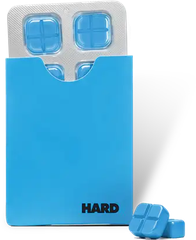
HardRx works on the vascular step: the sildenafil half shortens the wait, the tadalafil half widens the window so a specific moment does not have to be hit. Removing the deadline removes a good deal of what the anxiety was about. It does not, however, make you present — that part is still yours to do.
When to involve someone else
If the anxiety extends beyond the bedroom, if it is fuelling avoidance of relationships altogether, or if it sits on top of low mood, a therapist who works with sexual difficulty will get further than any tablet. Cognitive behavioural approaches have a solid record here. There is no prize for handling it alone, and this is a common enough problem that no clinician you speak to will find it novel.
Questions this raises
Yes. Sympathetic nervous system activity constricts the arteries that must relax for an erection to occur. The cause may be psychological but the mechanism is entirely physical.
Situational difficulty with normal morning erections points toward anxiety; consistent difficulty regardless of circumstance points toward a vascular cause. Many men have elements of both, and a clinician can help separate them.
Frequently, because it removes the run of failures the anxiety is drawing on. Some men use it for a period and then need it less often as expectation resets.
Most men who describe breaking the cycle mention having done so. Silence tends to be interpreted as disinterest, which adds a problem rather than avoiding one.
When you are ready
Five minutes of typing, an independent physician, free plain delivery.
More from the journal
Before you order
Take the dose you were prescribed and no more than one in any 24-hour period. HardRx is unsuitable alongside nitrate medication and with several heart conditions. Most side effects are mild — headache, flushing, a blocked nose, some light-headedness. None of this replaces a clinician who knows your history; read the full safety information first.
Get It Sorted
One assessment, one physician, one tablet that does both jobs.